Abandoned • Churches & Cemeteries • Historical • Chicago
ST. ADALBERT CHURCH
A cathedral built by immigrants with nothing. Shut down by the church that owned it. And a neighborhood that refuses to let it die.
Location
Pilsen, Chicago, Illinois
Built
1914
Closed
July 2019
Status
Landmarked — future uncertain

THE STORY
In 1874, Polish immigrants in Chicago’s Pilsen neighborhood founded St. Adalbert Parish. They had almost nothing — factory workers, laborers, families who had crossed an ocean to start over. But they had faith. And over the next four decades, they poured every spare cent into building a church that would rival anything they’d left behind in Europe.
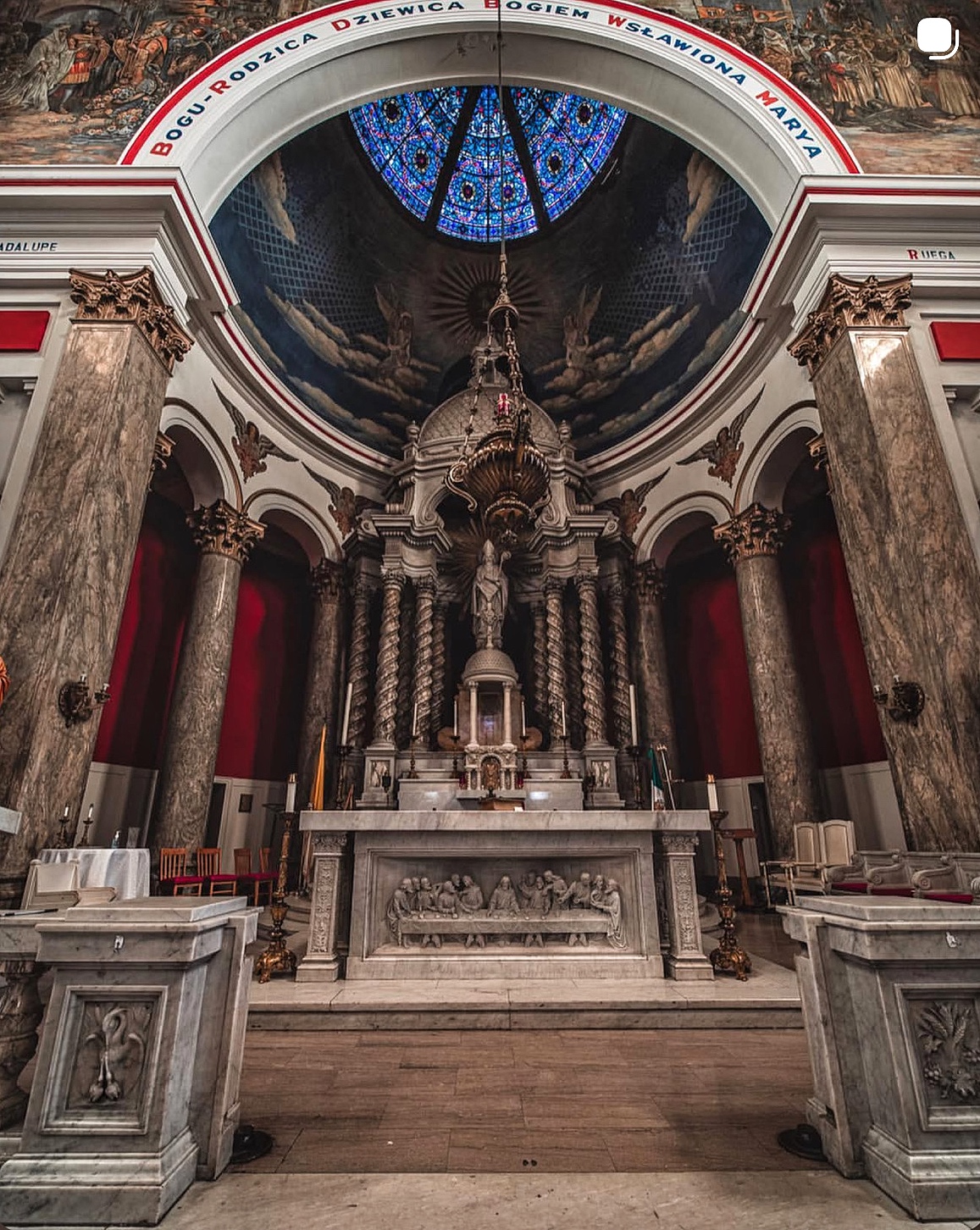
The result, completed in 1914, was staggering. Architect Henry J. Schlacks — who designed 15 Chicago-area churches in his career — modeled St. Adalbert after the Basilica of St. Paul Outside the Walls in Rome. Twin Baroque towers rise 185 feet over 17th Street. Inside, the sanctuary is a masterpiece of Renaissance Revival design: a 35-ton Carrara marble altar with ten spiral pillars capped by a dome-shaped canopy, beige-and-grey marble columns with gold capitals lining the nave, red-orange coffered ceiling panels, and a massive mural depicting the wedding of Queen Jadwiga of Poland and the victory of Our Lady of Czestochowa.
At its peak, St. Adalbert served 4,000 families. Over 2,000 children attended the parish school. It was the heart of Polish Catholic life on Chicago’s Lower West Side. The dark-varnished pews, the stained glass windows by F.X. Zettler of Munich, the hand-carved confessionals — all of it built by people who had nothing, as a gift to their God and to the country that took them in.
THE CLOSING
As decades passed, the neighborhood changed. The Polish families moved to the suburbs. Mexican immigrants moved in, and for years the church held Mass in both Polish and Spanish. But attendance kept declining. The building needed millions in repairs — the twin towers alone required $3 million in structural restoration. Monthly maintenance ran $15,000, while collection on a good month brought in a third of that. The debt climbed to $1.6 million.
In 2016, the Archdiocese of Chicago cited the dangerous state of repair and prohibitive costs and reduced the church’s function. In June 2019, they made it official — St. Adalbert was permanently closed. The congregation was merged with nearby St. Paul’s Church. The building was deconsecrated, meaning it was no longer considered sacred space and could no longer be used for worship. St. Adalbert became one of 115 churches closed across the city and suburbs under the archdiocese’s consolidation program called “Renew My Church.”
The doors closed. The scaffolding went up around the towers. Someone pitched a tent behind the boarded-up entrance — the only comfort the 110-year-old building could still offer anyone.
THE FIGHT
The archdiocese wanted to sell. The community wanted to save it. And for over five years, those two forces have been locked in one of the most heated preservation battles in Chicago’s history.
The Society of St. Adalbert, a group of former parishioners and preservation advocates, has fought relentlessly to protect the building. Preservation Chicago named it one of the city’s seven most endangered buildings four separate times — in 2014, 2016, 2019, and 2021. Four different buyers tried to purchase the property over the years — a music school, a real estate developer, a nonprofit housing group, a Miami-based company — and every deal fell through.
The archdiocese resisted landmark designation for years, arguing it would create a financial burden and make the property harder to sell. Meanwhile, preservationists watched in horror as the archdiocese began stripping the building. Workers cut into the church wall to remove a marble replica of Michelangelo’s Pieta and relocate it to another parish. Protesters were arrested trying to stop them.
In June 2025, the Chicago City Council finally granted St. Adalbert landmark status — but only for the sanctuary itself, not the full four-building campus. The rectory, convent, and school were left unprotected. A non-denominational church called the People Church has proposed buying the property, keeping the sanctuary for worship, and demolishing the other buildings to construct a community and youth center. Former parishioners are furious, calling it a betrayal of the building’s Catholic and Polish heritage. The fight continues.
WHAT’S LEFT INSIDE
Despite the years of neglect and the removal of some artifacts, the interior of St. Adalbert remains breathtaking. The 35-ton Carrara marble altar still stands with its ten spiral pillars and domed canopy. The pews — dark-varnished, with classical curved ornamentation — remain in their rows as if waiting for a congregation that will never return. The red-orange ceiling coffers still glow above the nave. The marble columns with their gold capitals still line the sanctuary.
The mural above the sanctuary — depicting the wedding of Queen Jadwiga and the miracle at Czestochowa — still stretches across the north wall in muted orange-red tones. The F.X. Zettler stained glass windows from Munich still catch the light. The original carved confessionals remain in the transept. Walking through St. Adalbert feels less like entering an abandoned building and more like stepping into a time capsule — everything preserved, everything untouched, everything waiting.
THE BIGGER PICTURE
St. Adalbert is not an isolated case. It’s a symbol of what’s happening to historic churches across America. The Archdiocese of Chicago alone has closed 115 parishes since 2018. Across the country, church attendance has plummeted — nearly three in ten Americans now identify as religiously unaffiliated, up from five percent in 1972. The buildings that immigrant communities scraped together every last penny to construct are now liabilities on a balance sheet.
What do you do with an empty church? A building designed for one purpose — worship — with stained glass, marble altars, and 185-foot towers that cost a fortune to maintain. Some are converted to condos. Some become event venues. Some are stripped for parts and demolished. And some, like St. Adalbert, sit empty while everyone argues about what should happen next.
The people who built St. Adalbert never imagined it would be abandoned. They built it to last forever. And architecturally, it can. The question is whether anyone will pay to keep it standing.
EXPLORATION NOTES
📍 Know Before You Go
St. Adalbert Church is located at 1650 W. 17th Street in Chicago’s Pilsen neighborhood. The building is closed to the public and owned by the Archdiocese of Chicago. Entry is not permitted. The exterior, including the twin Baroque towers and rose-colored granite columns, is visible from the street and makes for powerful photography.
The church was granted landmark status in June 2025, protecting the sanctuary from demolition. However, the rectory, convent, and school buildings remain unprotected. The future of the full campus is still being decided. Follow the Society of St. Adalbert and Preservation Chicago for updates on the ongoing preservation efforts.
Polish immigrants built this masterpiece with almost nothing. The least we can do is make sure it’s still standing when the next generation comes looking for it.
PHOTO GALLERY


Replace these placeholders with your own photography or licensed images.
Know more about this location? Have photos to share? Submit your own documentation and help us preserve the memory.