Abandoned • Historical • North Carolina
LAURINBURG-MAXTON AIRCRAFT BONEYARD
747s parked nose to nose in a field in the middle of nowhere. One had its head cut off and sent to the Smithsonian. The rest are still waiting.
Location
Maxton, North Carolina
Built
1942 (WWII airfield)
Aircraft Since
1953 (salvage operations)
Status
Closed to public — active salvage

THE STORY
When you think of airplane boneyards, you picture the Arizona desert — endless rows of military jets baking under a relentless sun. You don’t picture rural North Carolina. But two hours from Charlotte, tucked between small towns that most people have never heard of, sits one of the most surreal aviation graveyards in America.
Laurinburg-Maxton Airport covers 4,290 acres in Scotland County, straddling the line between the towns of Maxton and Laurinburg. The airfield was built for the United States Army Air Force during World War II as a training base for glider-towing aircraft. Local residents bought up a square mile of land and leased it to the federal government, which spent $10 million constructing the base. After the war ended in 1945, the Army had no use for it and gave the land back.
That’s when Harold “Jenks” Caldwell Sr. saw an opportunity. As the story goes, Caldwell was sitting in a restaurant when he noticed part of the building was constructed from a piece of a U.S. military aircraft. The idea clicked. In 1953, he founded what would become Charlotte Aircraft Corporation and set up shop at Laurinburg-Maxton, buying retired commercial airliners, stripping them for parts, and selling those parts back to airlines. The jet engines alone could fetch over $2 million each.
THE GRAVEYARD
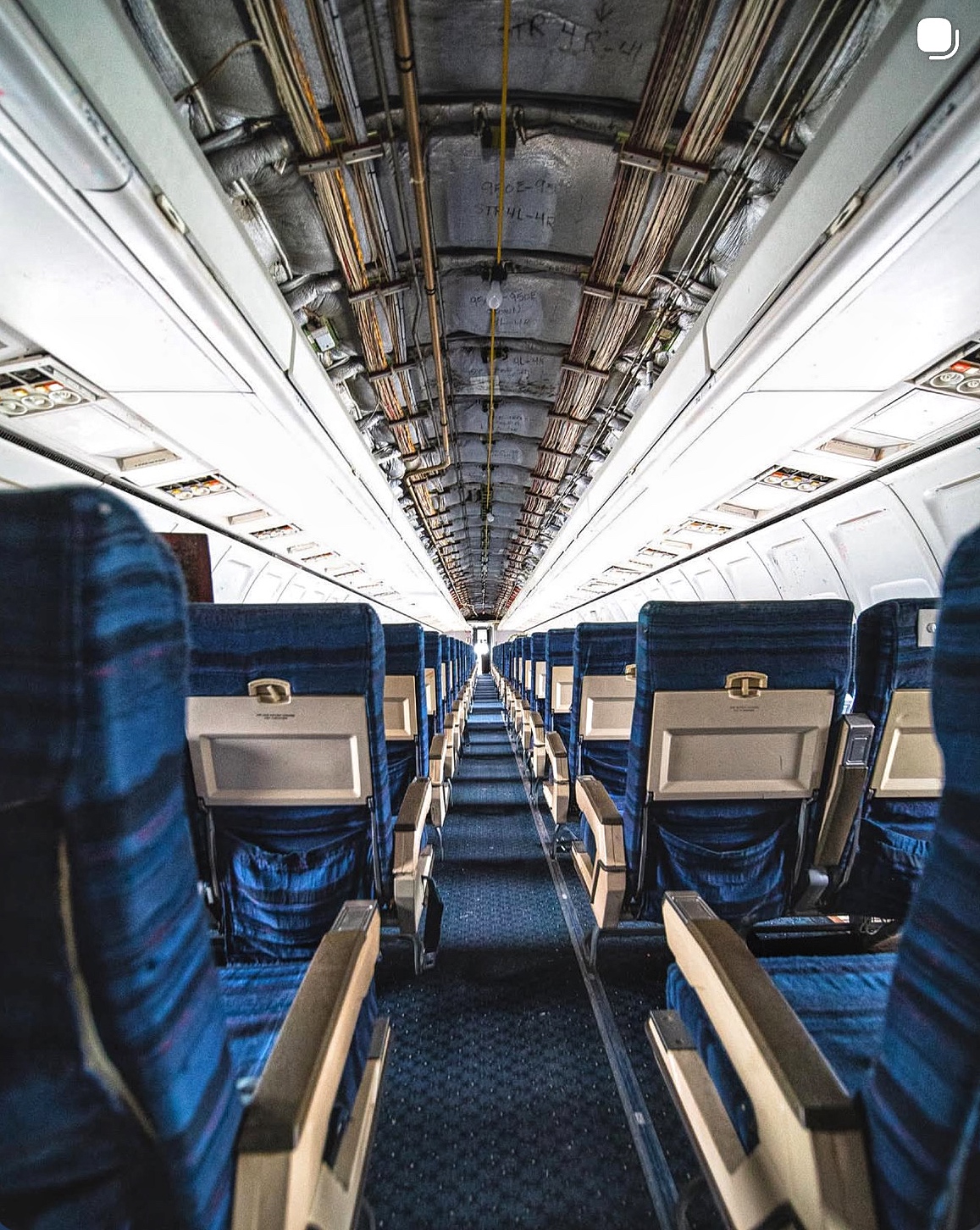
On any given day, you can find Boeing 747s, 727s, 737s, DC-10s, and even an Airbus A300 sitting in various states of decay on the old airfield. Most are former Northwest Airlines planes, sent here after the airline was absorbed by Delta in 2010. They arrive intact. Then the dismantling begins — engines first, then doors, rudders, electronics, wiring. Anything that can be sold is sold. What’s left is a hollow shell of aluminum and steel, sitting in a field with weeds growing through the landing gear.
The most famous aircraft in the boneyard was Northwest Airlines’ very first Boeing 747-100, delivered in May 1970 — one of the earliest 747s ever built. It flew for 24 years before being retired and sent to Maxton in 1994. In 2006, the plane’s nose was surgically removed and transported to Washington, D.C., where it now stands as the 747 on display at the National Air and Space Museum on the National Mall. The rest of the aircraft was scrapped where it sat.
A second 747 — the airline’s third ever — replaced it in the field. As of 2025, two 747s still sit parked nose to nose on the tarmac, engines removed, paint fading, like two old giants staring each other down with nothing left to say. Among the other aircraft is a Boeing 727 in Northwest Airlines colors — one of only two of its kind remaining in the world.
THE OTHER LIVES OF THE AIRFIELD
The boneyard isn’t the only strange tenant at Laurinburg-Maxton. The U.S. Army Golden Knights — the military’s elite parachute team — call the airfield home. Gryphon Group, a private military training company, has operated on the base since 2009, running combat simulations and tactical training for civilian and military personnel.
And from 1994 to 2011, the old two-mile runway hosted something no one expected — land speed racing. The East Coast Timing Association cleared the overgrown concrete, removed fully-grown trees, and held time trials five weekends a year. Hot rods, trucks, and motorcycles screamed down the former military runway. In 2010, a man named Bill Warner set the world record for motorcycle speed at 272.374 miles per hour — on a runway built for WWII glider training in the middle of rural North Carolina.
The North Carolina Highway Patrol even used the base to train cadets in high-speed car chases. Somewhere between the parachutists, the paramilitary contractors, and the speed demons, the airplane graveyard just quietly kept doing its thing — dismantling the past, one jet at a time.
EXPLORATION NOTES
⚠️ Important
As of 2017, the Laurinburg-Maxton Aircraft Boneyard is completely closed to the public. Charlotte Aircraft Corporation stopped allowing visitors after repeated trespassing, vandalism, and theft of aircraft parts. People have been arrested for entering the property. The airfield is also home to an active military parachute team and a private military training operation — this is not a place to wander uninvited.
The airport is located at Laurinburg-Maxton Airport, Maxton, NC 28364. Some of the aircraft can be seen from the perimeter fence and surrounding roads with a long lens. The boneyard is also clearly visible on Google Earth satellite imagery — zooming in on the airfield reveals the planes in stunning detail from above.
The Lost Directory does not encourage trespassing. These planes flew millions of passengers across the world. The least they deserve is to be left in peace. Photograph them from the fence. Remember what they were. Respect the graveyard.
PHOTO GALLERY


Replace these placeholders with your own photography or licensed images.
Know more about this location? Have photos to share? Submit your own documentation and help us preserve the memory.