Haunted • Churches & Cemeteries • New Orleans
ST. LOUIS CEMETERY NO. 1
100,000 dead in a single block. And the Voodoo Queen rules them all.
Location
French Quarter, New Orleans
Established
1789
Interred
100,000+ in 700 tombs
Status
Active — guided tours only

THE CITY OF THE DEAD
St. Louis Cemetery No. 1 spans a single city block just behind the French Quarter. That’s it — one block. But within those whitewashed walls lie more than 700 tombs containing an estimated 100,000 dead. The oldest existing cemetery in New Orleans, established by Spanish royal decree on August 14, 1789, it replaced the overcrowded Saint Peter Cemetery and has been burying the city’s dead for over 230 years. It’s still active today.
The tombs are above ground — a necessity in a city that sits below sea level. Bury a coffin in New Orleans soil and the water table pushes it back up. So the dead go into stone and plaster vaults that bake in the Louisiana sun, slowly reducing their contents to dust over time. A single family tomb can hold 60 to 100 people, stacked and decomposed over generations. Mark Twain saw this place and gave it the name that stuck: the Cities of the Dead.
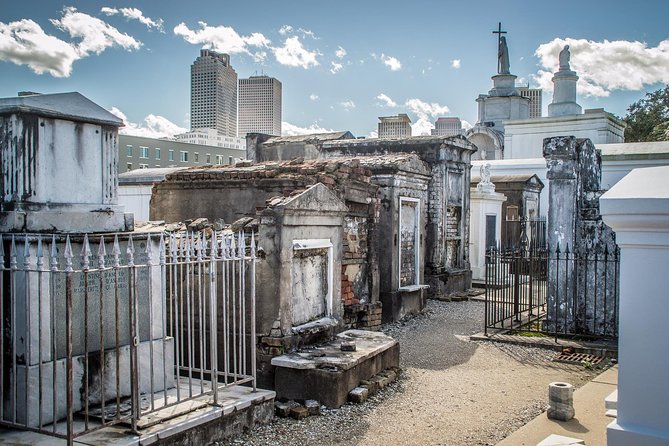
The layout is disorienting by design — or by age. Narrow corridors twist between crumbling tombs with cryptic symbols carved into their surfaces. Some vaults are pristine. Others are split open, exposing brick and bone. It looks less like a cemetery and more like a small, haunted city that’s been left to the elements for two centuries.
THE VOODOO QUEEN
The most famous resident of St. Louis Cemetery No. 1 — and arguably the most visited grave in America after Elvis Presley — is Marie Laveau. Born a free woman of color in 1801, Laveau became the most powerful Voodoo practitioner New Orleans has ever known. By day, she worked as a hairdresser to wealthy white women, learning their secrets. By night, she led Voodoo ceremonies at Congo Square that drew hundreds — enslaved and free, Black and white, curious and devout.
But Laveau was more than the sensationalized “Voodoo Queen” of legend. She was a healer who nursed the sick during yellow fever outbreaks. She ministered to condemned prisoners. She blended Catholic devotion with African spiritual traditions into something uniquely New Orleans — a practice that endures to this day. When she died on June 15, 1881, the city mourned a woman who had shaped its spiritual identity for decades.
She was interred in the Glapion family tomb at plot 347. The tomb is simple — unremarkable compared to many of the ornate vaults around it. But there is nothing simple about what happens there. For generations, visitors have drawn three Xs on the surface, turned around three times, knocked on the tomb, and called out a wish. If the wish was granted, you were expected to return, circle your Xs, and leave an offering.
The practice caused so much damage — including the tomb being painted Pepto-Bismol pink by vandals twice — that the Archdiocese of New Orleans closed the cemetery to unguided visitors in March 2015. Today, you can only enter with a licensed tour guide.
THE HAUNTINGS
St. Louis Cemetery No. 1 is considered one of the most haunted cemeteries in America. The activity is so frequent that the cemetery closes before sundown. Whatever walks these corridors doesn’t wait for midnight.
Marie Laveau’s spirit is the most commonly reported presence. Visitors have described being touched by unseen hands near her tomb. Others have become violently ill after mocking her grave, only to recover the moment they left the cemetery grounds. Some claim to have seen her apparition — a tall woman in a white dress and tignon headwrap, walking the corridors before vanishing behind a tomb. In interviews from the 1930s, a man named Eugene Lee Banks claimed to have met her ghost at a drugstore near the cemetery decades after her death. She slapped his face, leaped into the air, and flew over the cemetery wall.
But Laveau is not alone. The ghost of Henry Vignes, a 19th-century sailor, reportedly haunts his family’s tomb. Visitors describe a tall, pale man with intense eyes who appears from nowhere, asks if anyone has seen his papers, and disappears behind a headstone. Others have reported phantom Confederate soldiers, unexplained cold spots in the sweltering New Orleans heat, and the sound of Voodoo chanting echoing through the corridors when no one else is there.
THE FAMOUS DEAD
Marie Laveau is the biggest name, but St. Louis Cemetery No. 1 holds an extraordinary collection of New Orleans history within its walls. Homer Plessy — the civil rights activist whose act of defiance led to the landmark Plessy v. Ferguson Supreme Court case — rests here. So does Paul Morphy, one of the greatest chess players who ever lived, who went mad in his later years and was once found running naked through the French Quarter with an axe. Chess pieces still adorn his tomb.
Bernard de Marigny, the Creole aristocrat who popularized the game of craps in America, is buried here. Architect Benjamin Latrobe, who helped design the U.S. Capitol building, lies within these walls. And in a move that only makes sense in New Orleans, actor Nicolas Cage purchased a pyramid-shaped tomb for himself in the cemetery — gleaming white among the aged and crumbling vaults around it. He’s not dead yet, but his tomb is ready.
IN FILM AND CULTURE
St. Louis Cemetery No. 1 has appeared in countless films, TV shows, and books. Easy Rider filmed here. Interview with the Vampire used these corridors as a backdrop. Author Anne Rice drew deeply from the cemetery’s atmosphere to create the gothic world of her New Orleans vampire novels. Documentaries and paranormal investigation shows return again and again, drawn by the cemetery’s reputation as one of the most spiritually active locations in the country.
The cemetery’s connection to Voodoo — through Laveau and the broader spiritual tradition of New Orleans — makes it something more than a graveyard. It’s a site of living spiritual practice. Descendants of Laveau still visit to leave offerings. Practitioners still hold the space sacred. The line between the living and the dead here isn’t blurry — it barely exists.
VISITING
📍 Know Before You Go
Unlike the other locations on The Lost Directory, St. Louis Cemetery No. 1 is not abandoned. It’s an active cemetery that you can legally visit — but only with a licensed tour guide. Since March 2015, the Archdiocese of New Orleans has restricted public access due to vandalism and damage to the historic tombs.
Several tour companies offer guided visits, including daytime history tours and evening haunted tours. Photography is allowed and encouraged — the light cutting through the rows of crumbling white tombs makes for some of the most powerful shots you’ll take in New Orleans.
Do not mark, touch, or vandalize any tombs. Do not leave offerings at Marie Laveau’s tomb unless you are a descendant or practitioner with a legitimate connection. This is sacred ground. Respect it.
PHOTO GALLERY

Replace these placeholders with your own photography or licensed images.
Know more about this location? Have photos to share? Submit your own documentation and help us preserve the memory.